
Lung Disease
Our vision is to use human stem cells to develop new treatments for acute and chronic respiratory diseases.
Our lungs are essential for bringing oxygen into our bodies. However, with every breath, our lungs are exposed to pollutants and germs in the environment, which can lead to respiratory illnesses.
Children are especially vulnerable to many respiratory infections, and there are no vaccines to protect against some of these illnesses. Additionally, some children are born with lung conditions, like cystic fibrosis, which makes fighting infections even harder.
Our research
In our lab, we use human-induced pluripotent stem cells to create models of the human lung. We study how different lung cells interact, including epithelial cells that line the airways, immune cells that protect the lungs, and structural support cells; both in healthy lungs and during infections.
We can also create stem cell models from donors with conditions such as cystic fibrosis, alpha-1 antitrypsin deficiency, and childhood interstitial lung disease to better understand how chronic lung diseases start and progress.
Our goal
By using these stem cell-derived lung models, we aim to identify and test new treatments for respiratory diseases.
What we see under the microscope
This image below shows airway epithelial cells differentiated from pluripotent stem cells carrying a genetic mutation that causes Cystic Fibrosis. The airway epithelium forms a protective barrier through tight junctions (white) and consists of specialised cell types, including ciliated cells (red) and secretory cells (green), which help defend against inhaled respiratory pathogens.
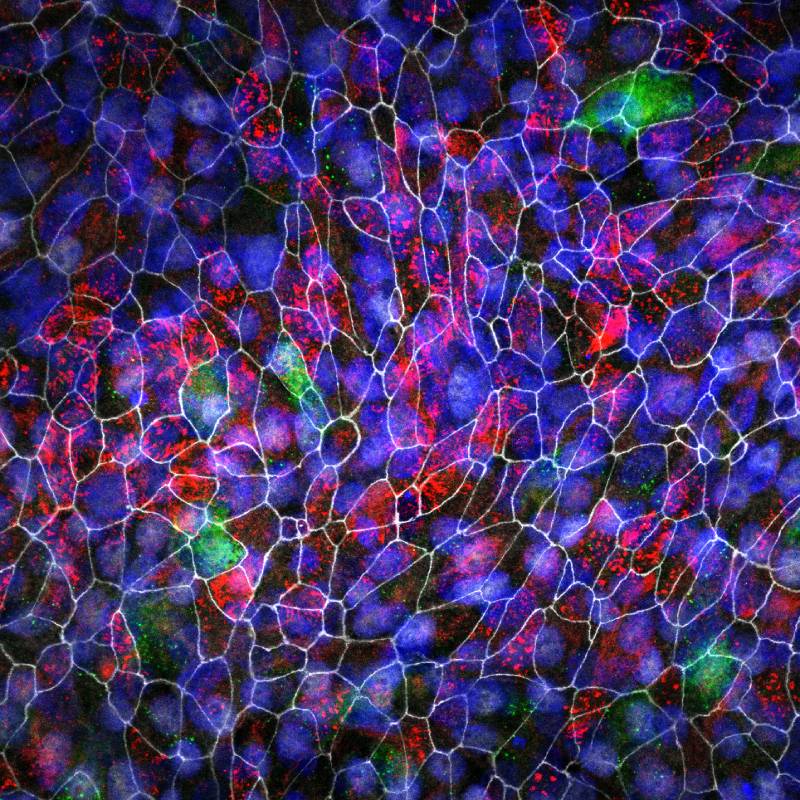
Image credit: Katelyn Patatsos, Declan Turner
Watch Dr Rhiannon Werder talk about infections and other lung diseases using models of human lung tissue grown from stem cells
This video is published with permission from Audienced Films.
More information
Group Leaders

Group Members





Our projects

Resolving respiratory infections
This study seeks to understand the cellular and molecular events that follow a respiratory infection, to find new therapeutic approaches.
Read more...
Stem cell models to decode chronic lung diseases
This study investigates chronic lung diseases using stem cell models. This research leverages induced pluripotent stem cell (iPSC)-derived lung models from individuals with chronic lung diseases to explore disease mechanisms and immune responses during respiratory infections.
Read more...
Targeting post-viral pulmonary fibrosis
This study aims to uncover the signals that govern the balance between effective lung repair and maladaptive fibrosis following respiratory viral infections, with the goal of identifying therapeutic targets to improve recovery and prevent long-term pulmonary fibrosis.
Read more...Funding
- Medical Research Future Fund
- Novo Nordisk Foundation Center for Stem Cell Medicine, reNEW
- L.E.W. Carty Trust
- Alpha-1 Foundation
- Australian Functional Genomics Network
Collaborations
MCRI:
- Prof Sarath Ranganathan
- Dr Shivanthan Shanthikumar
- A/Prof Melanie Neeland
- Associate Professor Richard Mills
- Professor Andrew Steer
- Associate Professor Paul Licciardi
- Associate Professor Catherine Satzke
- Dr Prue Perreira
- Dr Sohinee Sarkar
External:
- Prof Kanta Subbarao, Peter Doherty Centre for Infection and Immunity
- Prof Sharon Lewin and Wei Zhao, Peter Doherty Centre for Infection and Immunity
- A/Prof Lisa Kaminskas, University of Queensland
- A/Prof Simon Phipps, QIMR Berghofer
- Prof Paul Hertzog, Hudson Medical Research Institute
- Prof Andrew Wilson, Boston University
Features publications
Turner DL, Amoozadeh S, Baric H, Stanley E, Werder RB. Building a human lung from pluripotent stem cells to model respiratory viral infections. Respir Res. 2024 Jul 15;25(1):277. doi: 10.1186/s12931-024-02912-0. PMID: 39010108; PMCID: PMC11251358.
Werder RB, Liu T, Abo KM, Lindstrom-Vautrin J, Villacorta-Martin C, Huang J, Hinds A, Boyer N, Bullitt E, Liesa M, Silverman EK, Kotton DN, Cho MH, Zhou X, Wilson AA. CRISPR interference interrogation of COPD GWAS genes reveals the functional significance of desmoplakin in iPSC-derived alveolar epithelial cells. Sci Adv. 2022 Jul 15;8(28):eabo6566. doi: 10.1126/sciadv.abo6566. Epub 2022 Jul 13. PMID: 35857525; PMCID: PMC9278866.
Werder RB, Berthiaume KA, Merritt C, Gallagher M, Villacorta-Martin C, Wang F, Bawa P, Malik V, Lyons SM, Basil MC, Morrisey EE, Kotton DN, Zhou X, Cho MH, Wilson AA. The COPD GWAS gene ADGRG6 instructs function and injury response in human iPSC-derived type II alveolar epithelial cells. Am J Hum Genet. 2023 Oct 5;110(10):1735-1749. doi: 10.1016/j.ajhg.2023.08.017. Epub 2023 Sep 20. PMID: 37734371; PMCID: PMC10577075.
Werder RB, Kaserman JE, Packer MS, Lindstrom-Vautrin J, Villacorta-Martin C, Young LE, Aratyn-Schaus Y, Gregoire F, Wilson AA. Adenine base editing reduces misfolded protein accumulation and toxicity in alpha-1 antitrypsin deficient patient iPSC-hepatocytes. Mol Ther. 2021 Nov 3;29(11):3219-3229. doi: 10.1016/j.ymthe.2021.06.021. Epub 2021 Jul 2. PMID: 34217893; PMCID: PMC8571173.
Werder RB, Huang J, Abo KM, Hix OT, Minakin K, Alysandratos KD, Merritt C, Berthiaume K, Alber AB, Burgess CL, Kotton DN, Wilson AA. Generating 3D Spheres and 2D Air-Liquid Interface Cultures of Human Induced Pluripotent Stem Cell-Derived Type 2 Alveolar Epithelial Cells. J Vis Exp. 2022 Apr 15;(182). doi: 10.3791/63875. PMID: 35499347.
Huang J, Hume AJ, Abo KM, Werder RB, Villacorta-Martin C, Alysandratos KD, Beermann ML, Simone-Roach C, Lindstrom-Vautrin J, Olejnik J, Suder EL, Bullitt E, Hinds A, Sharma A, Bosmann M, Wang R, Hawkins F, Burks EJ, Saeed M, Wilson AA, Mühlberger E, Kotton DN. SARS-CoV-2 Infection of Pluripotent Stem Cell-Derived Human Lung Alveolar Type 2 Cells Elicits a Rapid Epithelial-Intrinsic Inflammatory Response. Cell Stem Cell. 2020 Dec 3;27(6):962-973.e7. doi: 10.1016/j.stem.2020.09.013. Epub 2020 Sep 18. PMID: 32979316; PMCID: PMC7500949.
Werder RB, Ullah MA, Rahman MM, Simpson J, Lynch JP, Collinson N, Rittchen S, Rashid RB, Sikder MAA, Handoko HY, Curren BF, Sebina I, Hartel G, Bissell A, Ngo S, Yarlagadda T, Hasnain SZ, Lu W, Sohal SS, Martin M, Bowler S, Burr LD, Martinez LO, Robaye B, Spann K, Ferreira MAR, Phipps S. Targeting the P2Y13 Receptor Suppresses IL-33 and HMGB1 Release and Ameliorates Experimental Asthma. Am J Respir Crit Care Med. 2022 Feb 1;205(3):300-312. doi: 10.1164/rccm.202009-3686OC. PMID: 34860143.
Lung disease newsroom

Dr Rhiannon Werder receives MRFF grant to transform lung disease care

Resilience forged against rare condition

Flourishing with a chronic condition
Stem cell models to decode chronic lung diseases
Resolving respiratory infections
Targeting post-viral pulmonary fibrosis

Global action needed to solve the medical oxygen crisis

Searching for support

Hep B vaccine does not increase risk of chronic lung disease in preterm babies

Meet our brilliant minds: Prue Pereira-Fantini

Metcalf Prize awarded to Dr Rhiannon Werder
